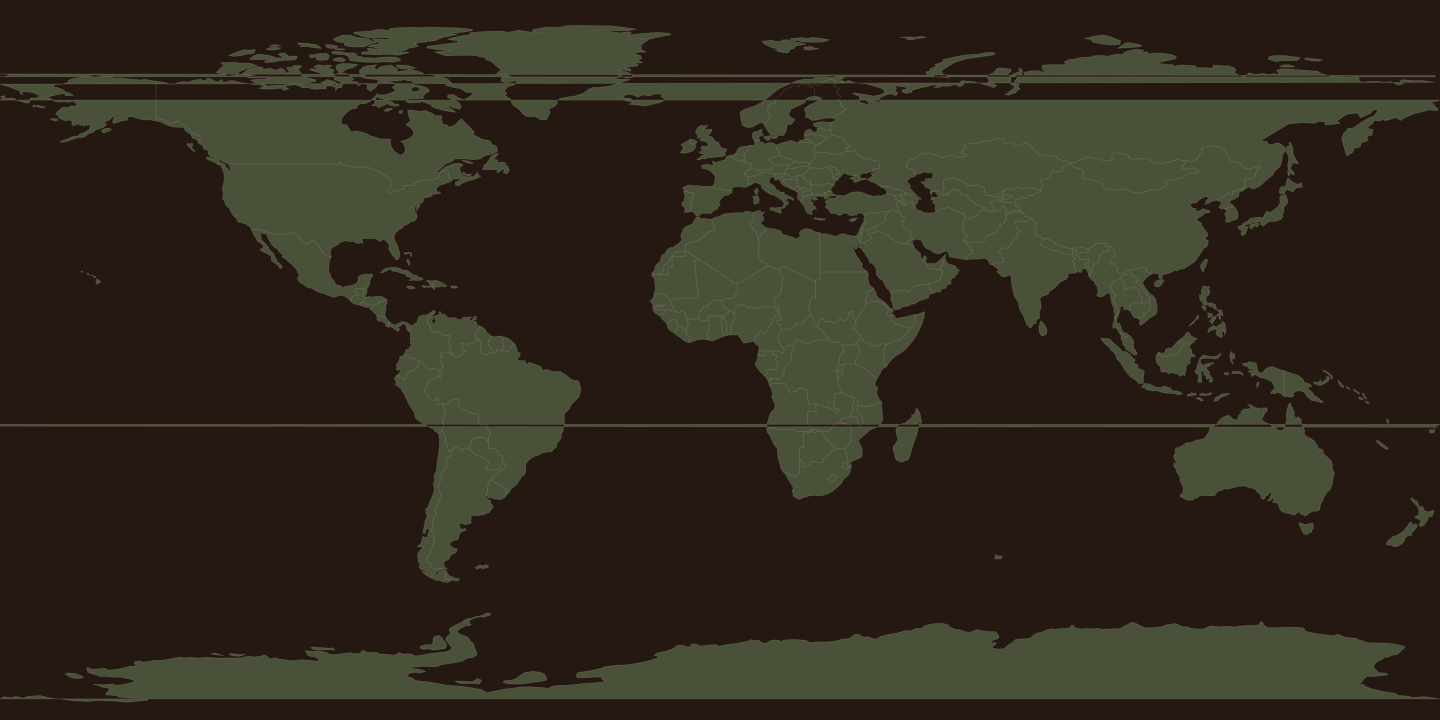
A qualitative orientation, not a live production ranking.
Origin field file / West Africa← All origins
Côte d’Ivoire
Understand the scale of everyday chocolate—and why volume, forest, labor and living income must be read together.
cocoaroasted nutsmalt
- Côte d’Ivoire — West Africa, Forest zone, at approximately 7.5° north and 5.5° west.
- Ghana — West Africa, Ashanti, Western North & Ahafo, at approximately 7.8° north and 1.0° west.
- Ecuador — Latin America, Esmeraldas, Manabí, Los Ríos & Guayas, at approximately 1.4° south and 78.2° west.
- Peru — Latin America, Amazonas, San Martín, Piura & Cusco, at approximately 9.2° south and 75.0° west.
- Venezuela — Latin America, Sur del Lago, Paria, Ocumare & Chuao, at approximately 7.0° north and 66.6° west.
- Dominican Republic — Caribbean, Cibao, Duarte & Sánchez Ramírez, at approximately 19.0° north and 70.2° west.
- Madagascar — East Africa, Sambirano Valley, at approximately 14.5° south and 47.0° east.
- Brazil — Latin America, Bahia & Pará, at approximately 10.0° south and 50.0° west.
- Indonesia — Southeast Asia, Sulawesi, Sumatra & Bali, at approximately 2.0° south and 119.0° east.
- India — India, Andhra Pradesh, Karnataka, Kerala & Tamil Nadu, at approximately 12.0° north and 77.5° east.
- Nigeria — West Africa, Ondo, Cross River & Osun, at approximately 9.0° north and 8.0° east.
- Cameroon — West Africa, Centre, South & Littoral, at approximately 6.0° north and 12.0° east.
- Papua New Guinea — Oceania, East New Britain & Bougainville, at approximately 6.0° south and 147.0° east.
- Belize — Latin America, Toledo District, at approximately 17.2° north and 88.7° west.
- Tanzania — East Africa, Mbeya, Morogoro & Kyela, at approximately 7.0° south and 35.0° east.
Atlas originBand is climatic orientation, not a biological border
Windows vary by region, weather and crop cycle.
System labels describe patterns, not every farm.
Each pressure requires its own evidence and response.
How to read this fileCountry is context,
Country is context,
never destiny.
Côte d’Ivoire is central to the global cocoa economy. Its forest-zone farms supply a large share of the beans used in mainstream chocolate, cocoa powder and industrial formulations. A national name therefore covers immense variation in farm size, planting material, buying channels and post-harvest practice.
The useful lesson is not that Ivorian cocoa has one flavor. It is that scale creates both capability and exposure: organized quality systems can move enormous volumes, while low household income, hazardous child-labor risk, deforestation and land-tenure questions cannot be solved by a wrapper-level origin story.
Four forces to keep in frame.
Planting material
Productive Forastero-derived and hybrid material is widespread; genetic shorthand does not predict a single sensory result.
Post-harvest
Heap and other fermentation systems vary. Aggregation can combine farms and reduce lot specificity unless separation is designed into the chain.
Market structure
Regulated farmgate pricing and export systems shape incentives; retail price does not map directly to farmer income.
Land and labor
Forest protection, land rights, household economics and hazardous child labor require distinct monitoring and remediation mechanisms.
Sensory prompts—not promises
cocoa depth · roasted nuts · malt · brown spice
These associations can help build a flight. They cannot authenticate origin, genetics or quality. Taste blind when possible and record the roast, recipe and serving conditions.
Start a Côte d’Ivoire tasting ↗Keep the caveats visible
— Do not equate bulk with careless.
— Do not treat one certification as proof of living income.
— Do not turn farmers into anonymous background for a maker story.
Turn romance into evidence.
- 01Can the company trace to cooperative or farm?
- 02How is price or premium calculated and delivered?
- 03What child-labor monitoring and remediation exists?
- 04How is recent forest conversion assessed?