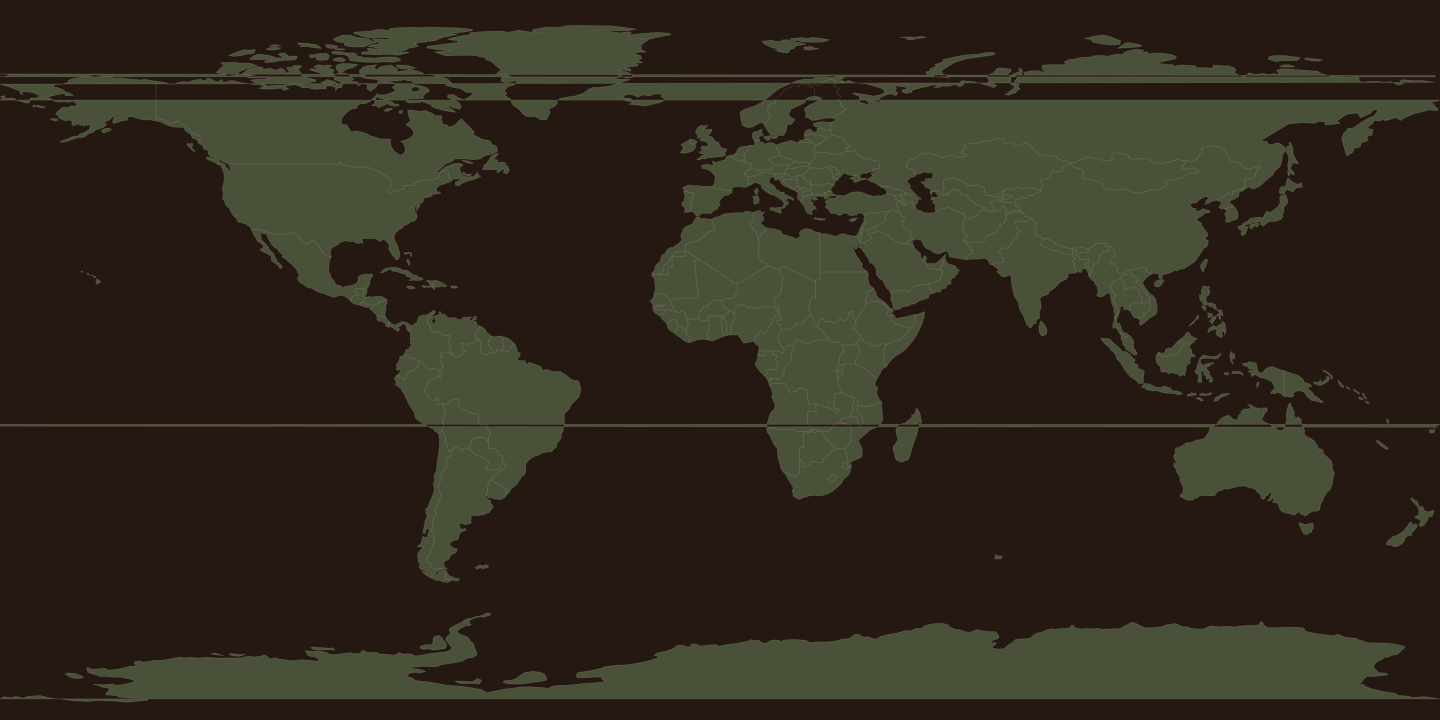
A qualitative orientation, not a live production ranking.
Origin field file / West Africa← All origins
Ghana
A major origin where national quality institutions, classic cocoa character and household resilience meet.
classic cocoamaltroasted peanut
- Côte d’Ivoire — West Africa, Forest zone, at approximately 7.5° north and 5.5° west.
- Ghana — West Africa, Ashanti, Western North & Ahafo, at approximately 7.8° north and 1.0° west.
- Ecuador — Latin America, Esmeraldas, Manabí, Los Ríos & Guayas, at approximately 1.4° south and 78.2° west.
- Peru — Latin America, Amazonas, San Martín, Piura & Cusco, at approximately 9.2° south and 75.0° west.
- Venezuela — Latin America, Sur del Lago, Paria, Ocumare & Chuao, at approximately 7.0° north and 66.6° west.
- Dominican Republic — Caribbean, Cibao, Duarte & Sánchez Ramírez, at approximately 19.0° north and 70.2° west.
- Madagascar — East Africa, Sambirano Valley, at approximately 14.5° south and 47.0° east.
- Brazil — Latin America, Bahia & Pará, at approximately 10.0° south and 50.0° west.
- Indonesia — Southeast Asia, Sulawesi, Sumatra & Bali, at approximately 2.0° south and 119.0° east.
- India — India, Andhra Pradesh, Karnataka, Kerala & Tamil Nadu, at approximately 12.0° north and 77.5° east.
- Nigeria — West Africa, Ondo, Cross River & Osun, at approximately 9.0° north and 8.0° east.
- Cameroon — West Africa, Centre, South & Littoral, at approximately 6.0° north and 12.0° east.
- Papua New Guinea — Oceania, East New Britain & Bougainville, at approximately 6.0° south and 147.0° east.
- Belize — Latin America, Toledo District, at approximately 17.2° north and 88.7° west.
- Tanzania — East Africa, Mbeya, Morogoro & Kyela, at approximately 7.0° south and 35.0° east.
Atlas originBand is climatic orientation, not a biological border
Windows vary by region, weather and crop cycle.
System labels describe patterns, not every farm.
Each pressure requires its own evidence and response.
How to read this fileCountry is context,
Country is context,
never destiny.
Ghana’s cocoa system is often associated with consistent fermentation and a robust, familiar cocoa profile. National institutions influence grading, quality control and export. Those systems help explain reputation, but they do not erase regional, farm or harvest variation.
Aging trees, disease, climate pressure and household income shape what quality is possible. When a maker describes Ghana only through dependable cocoa flavor, ask how purchasing and post-harvest incentives support the people maintaining that consistency.
Four forces to keep in frame.
Production landscape
Smallholder farms across major cocoa regions operate within a nationally coordinated marketing and quality system.
Post-harvest
Well-fermented export traditions can support cocoa, malt and nut expression; drying and storage still vary.
Renewal
Aging farms, swollen-shoot virus and replanting costs affect output and household risk.
Livelihoods
Farmgate price, yield, farm size, costs and other income all matter to a living-income analysis.
Sensory prompts—not promises
classic cocoa · malt · roasted peanut · gentle fruit
These associations can help build a flight. They cannot authenticate origin, genetics or quality. Taste blind when possible and record the roast, recipe and serving conditions.
Start a Ghana tasting ↗Keep the caveats visible
— National consistency is not uniformity.
— Quality control does not prove household prosperity.
— Avoid comparing Ghana and Côte d’Ivoire as one interchangeable system.
Turn romance into evidence.
- 01Which region and crop year?
- 02Who fermented and dried the lot?
- 03How does the buyer support farm renewal?
- 04What evidence covers labor and income outcomes?