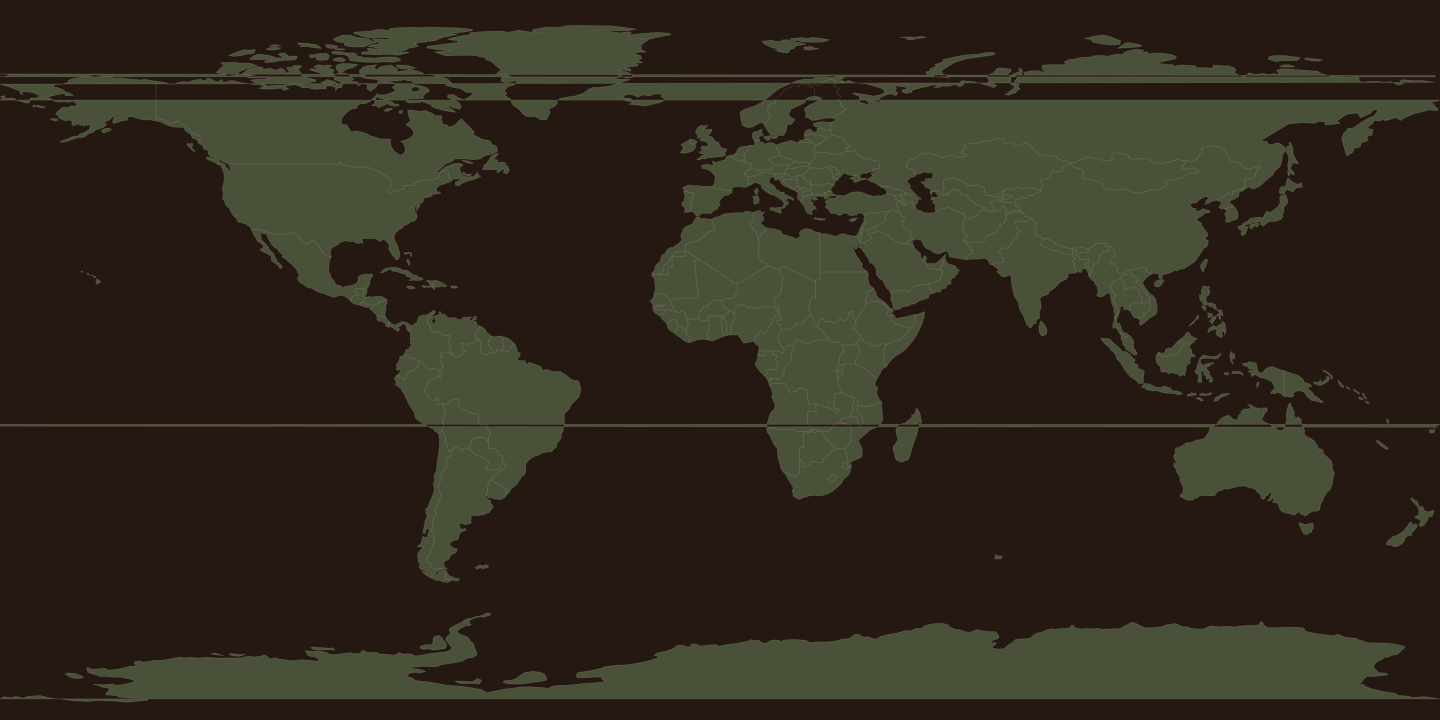
A qualitative orientation, not a live production ranking.
Origin field file / Latin America← All origins
Peru
A country-scale label covering Amazonian valleys, northern dry forests, mixed genetics and distinct post-harvest networks.
red fruitpanelanuts
- Côte d’Ivoire — West Africa, Forest zone, at approximately 7.5° north and 5.5° west.
- Ghana — West Africa, Ashanti, Western North & Ahafo, at approximately 7.8° north and 1.0° west.
- Ecuador — Latin America, Esmeraldas, Manabí, Los Ríos & Guayas, at approximately 1.4° south and 78.2° west.
- Peru — Latin America, Amazonas, San Martín, Piura & Cusco, at approximately 9.2° south and 75.0° west.
- Venezuela — Latin America, Sur del Lago, Paria, Ocumare & Chuao, at approximately 7.0° north and 66.6° west.
- Dominican Republic — Caribbean, Cibao, Duarte & Sánchez Ramírez, at approximately 19.0° north and 70.2° west.
- Madagascar — East Africa, Sambirano Valley, at approximately 14.5° south and 47.0° east.
- Brazil — Latin America, Bahia & Pará, at approximately 10.0° south and 50.0° west.
- Indonesia — Southeast Asia, Sulawesi, Sumatra & Bali, at approximately 2.0° south and 119.0° east.
- India — India, Andhra Pradesh, Karnataka, Kerala & Tamil Nadu, at approximately 12.0° north and 77.5° east.
- Nigeria — West Africa, Ondo, Cross River & Osun, at approximately 9.0° north and 8.0° east.
- Cameroon — West Africa, Centre, South & Littoral, at approximately 6.0° north and 12.0° east.
- Papua New Guinea — Oceania, East New Britain & Bougainville, at approximately 6.0° south and 147.0° east.
- Belize — Latin America, Toledo District, at approximately 17.2° north and 88.7° west.
- Tanzania — East Africa, Mbeya, Morogoro & Kyela, at approximately 7.0° south and 35.0° east.
Atlas originBand is climatic orientation, not a biological border
Windows vary by region, weather and crop cycle.
System labels describe patterns, not every farm.
Each pressure requires its own evidence and response.
How to read this fileCountry is context,
Country is context,
never destiny.
Peruvian cacao reaches chocolate makers from very different landscapes, including Amazonas, San Martín, Cusco and Piura. White-seeded, native and named genetic stories receive attention, but national flavor descriptions flatten a highly diverse production map.
Cacao has also appeared in crop-diversification and alternative-livelihood programs. Those histories deserve precise evaluation: market access, farm resilience and long-term local capacity matter more than a heroic substitution narrative.
Four forces to keep in frame.
Diversity
Ecology and planting material vary widely; country-level flavor notes are especially provisional.
Post-harvest hubs
Cooperatives and centralized systems can create consistency and lot separation when incentives and infrastructure align.
Dry north
Piura’s conditions and planting material differ markedly from humid Amazonian regions.
Market access
Remote logistics and the durability of quality premiums shape farmer participation.
Sensory prompts—not promises
red fruit · panela · nuts · dried flowers
These associations can help build a flight. They cannot authenticate origin, genetics or quality. Taste blind when possible and record the roast, recipe and serving conditions.
Start a Peru tasting ↗Keep the caveats visible
— White beans do not guarantee delicate flavor.
— Native does not mean genetically unmixed.
— Alternative-livelihood claims need outcome evidence.
Turn romance into evidence.
- 01Which valley or cooperative?
- 02How is fermentation centralized or supported?
- 03Does the lot remain separated through export?
- 04What does the quality premium pay for?