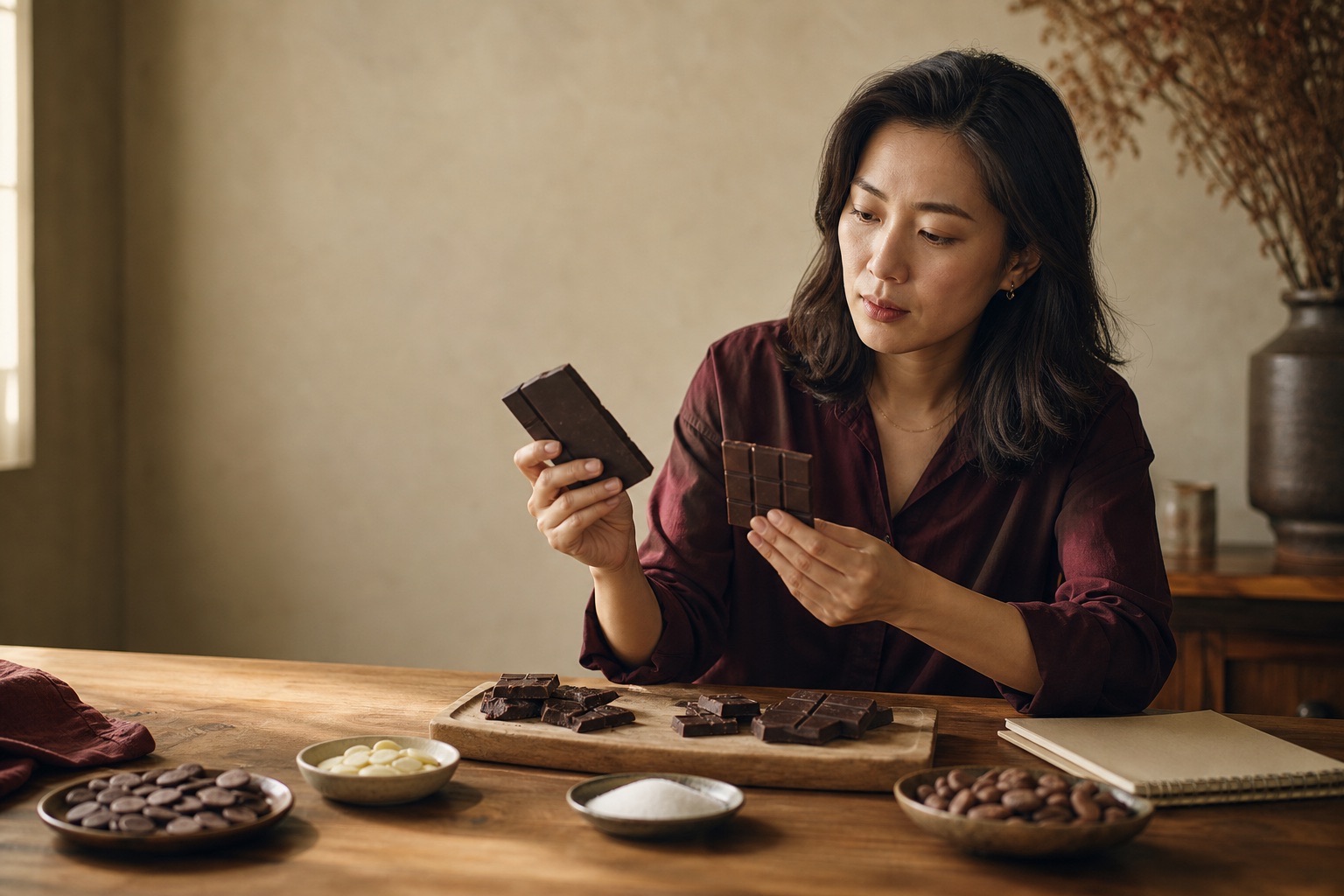
What does 70% mean?
A cacao percentage counts part of a recipe. It does not grade the result.
By the end, you can…
- 01Explain what the large percentage on a typical dark-chocolate label is counting.
- 02Distinguish cocoa mass from cocoa butter added separately to a recipe.
- 03Compare two different 70% formulations without confusing composition with quality.
- 04Read a front claim and ingredient list without claiming more than the evidence supports.
Begin with a 100-gram bar
Imagine a plain 100 g dark-chocolate bar marked 70% cacao. As a first model, read the number this way: about 70 g belong to the declared cacao portion and about 30 g remain for sugar and any other non-cacao ingredients.
That model is useful, but it is only the outer shell of the recipe. It does not mean 70 g of cocoa powder. It does not mean 70 g of the brown, non-fat part of the bean. And unless the bar contains only cacao ingredients and sugar, the remaining 30 g is not automatically all sugar. Lecithin, vanilla, milk, fruit, nuts or a filling can occupy some of that space.
There is also a legal caveat: on an EU-style declaration, the percentage refers to at least that much total dry cocoa solids in the chocolate portion. Product definitions and required wording differ between markets, especially in the United States. We will compare them later rather than pretending that one sentence is universal.1, 4, 6
“Cacao” is not one ingredient
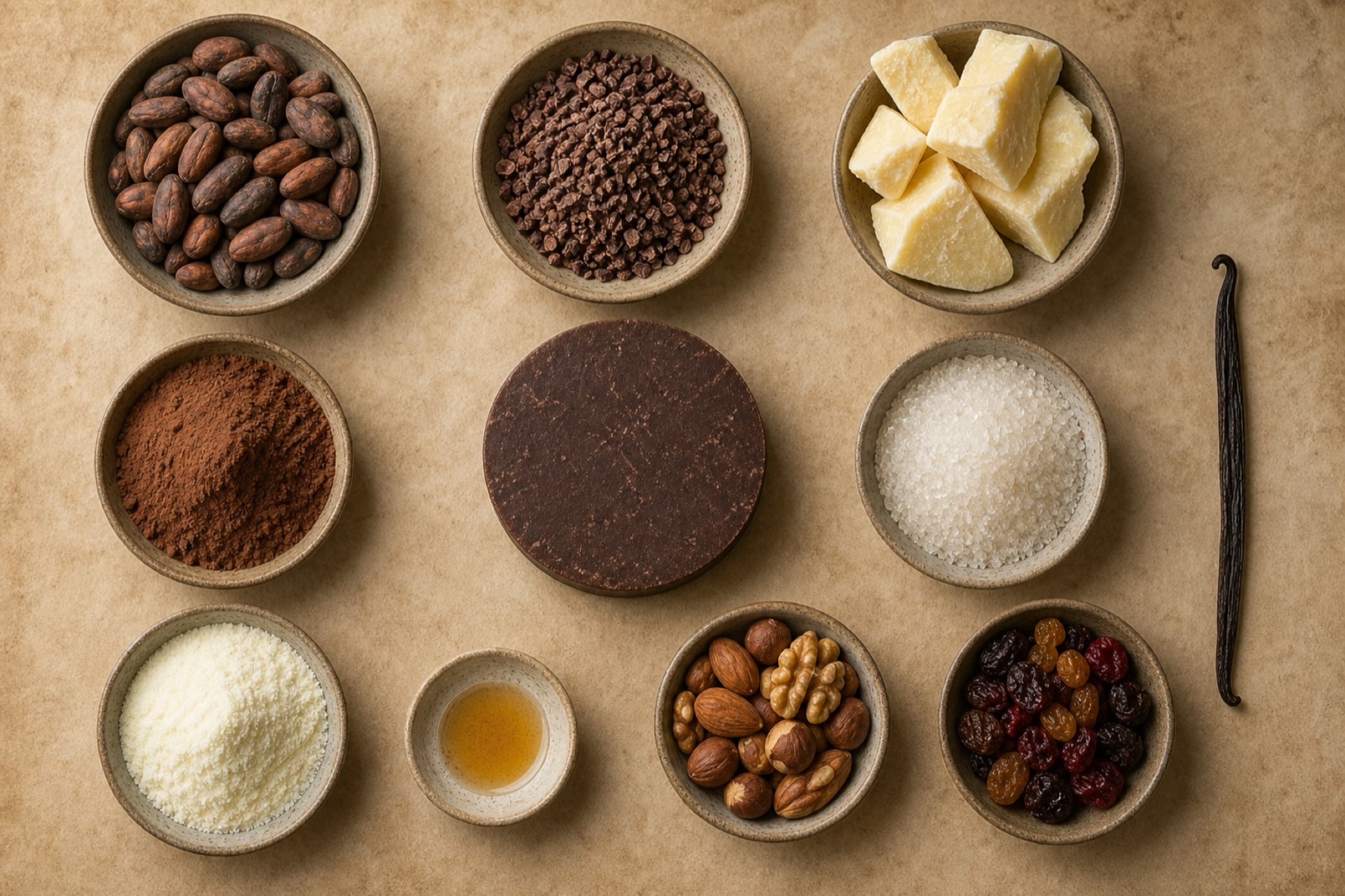
Cocoa mass—also called cocoa liquor or cocoa paste—is made by grinding cacao nibs. “Liquor” here does not mean alcohol. The nib naturally contains both cocoa butter, the seed’s fat, and non-fat cocoa material that supplies much of chocolate’s color, structure and many of its bitter, acidic and aromatic compounds.
Standards illustrate how substantial the native fat is: Codex specifies 47–60% cocoa butter in cocoa mass, while the U.S. standard for chocolate liquor specifies 50–60% cacao fat.2, 5 So when a label lists “cocoa mass,” cocoa butter is already present inside it.
Separately listed cocoa butter is additional extracted fat. Makers may add it to change the fat-to-particle balance and the way the chocolate behaves during refining, conching, molding and eating. A larger fat phase can often help molten chocolate flow, but particle size, emulsifiers, moisture, processing and temperature matter too. “More added butter” is not a synonym for “better,” “creamier” or “more refined.”10
Two bars, both 70%
Which recipe contains more non-fat cocoa material? Which contains more total cocoa butter? The shared front number cannot answer either question by itself.
More cocoa mass
- Native butter in mass
- 35.75 g
- + Added cocoa butter
- 5 g
- ≈ Total cocoa butter
- 40.75 g
- ≈ Non-fat cocoa material
- 29.25 g
More added butter
- Native butter in mass
- 30.25 g
- + Added cocoa butter
- 15 g
- ≈ Total cocoa butter
- 45.25 g
- ≈ Non-fat cocoa material
- 24.75 g
For both examples, we pretend the cocoa mass is exactly 55% cocoa butter and 45% non-fat material. Recipe A: 65 × .55 = 35.75 g native butter. Recipe B: 55 × .55 = 30.25 g. These are transparent teaching calculations, not recipes copied from a maker.
Recipe B therefore has about 4.5 g more total cocoa butter and 4.5 g less non-fat cocoa material than Recipe A, even though both wrappers could carry the same large number. With the same mass and processing assumptions, Recipe B may be more fluid when molten because its fat phase is larger. That is a reasonable hypothesis—not a promise about taste or texture.
Different cacao genetics, fermentation, drying, roasting, particle size, conching, emulsifier use, temper and storage can overpower this one recipe difference. The math tells you what changed in our hypothetical formulations. It cannot award a quality score.
What the number tells, suggests and withholds
Good label reading is disciplined inference: say exactly what the evidence earns.
The declared cacao share
Under the convention used on that label, the number identifies the stated or minimum share assigned to cacao-derived material. In a genuinely two-ingredient bar, it can also help estimate the sugar share.
How much recipe space remains
An 85% plain bar leaves less room for non-cacao ingredients than a comparable 70% plain bar. It may contain less sugar, but perceived sweetness still depends on much more than arithmetic.
Whether the bar is good
The percentage hides the mass-to-butter split, bean quality, fermentation, roast, particle size, sourcing conditions, freshness, flavor balance—and whether you will enjoy it.
Read the back, not only the front
Inspect this fictional wrapper before opening the annotations. What is stated? What can you infer? What is still impossible to know?
Dark chocolate
Learning label · 80 gIngredients: cocoa mass, cane sugar, cocoa butter, sunflower lecithin, natural vanilla.
May contain: milk and tree nuts.
Fictional formulation for education only.Reveal six label annotations +
- 01
“70% minimum” is a floor. It does not disclose the exact cocoa-mass-to-cocoa-butter split.
- 02
Cocoa mass and cocoa butter are separate entries. That proves additional cocoa butter was used beyond the butter already inside the mass.
- 03
The order gives rank, not quantities. In the EU and U.S., ingredients are generally listed by descending weight, with defined exceptions.8, 9
- 04
The bar is not provably 30% sugar. Lecithin and vanilla occupy part of the remaining share, and “minimum” allows further uncertainty.
- 05
“May contain” is a cross-contact warning. It does not declare milk or nuts as intended ingredients in this fictional recipe.
- 06
The production story remains absent. Nothing here proves bean quality, farmer income, fermentation, roast skill, freshness or flavor balance.
Labels are local legal documents
“70% cacao” is common consumer shorthand, but chocolate standards do not use identical definitions everywhere. Compare the sales name, the exact percentage wording, the ingredient list and nearby qualifiers before treating bars from different markets as equivalents.
International benchmark
Codex defines chocolate at a minimum 35% total cocoa solids on a dry-matter basis, including minimum cocoa-butter and fat-free-cocoa-solids levels. Its texts guide national systems; they are not automatically national law.1, 3
A minimum declaration
Covered chocolate categories carry wording such as “cocoa solids: 70% minimum.” EU “chocolate” must contain at least 35% total dry cocoa solids, including at least 18% cocoa butter and 14% dry non-fat cocoa solids.4
Comparable thresholds
FSSAI’s dark-chocolate standard likewise specifies at least 35% total cocoa solids, including at least 18% cocoa butter and 14% fat-free cocoa solids. Product and labelling rules still need to be read in their Indian context.7
A different calculation
U.S. standards define semisweet and bittersweet chocolate through calculated chocolate-liquor content and permit added cacao fat. They do not reproduce the EU minimum-cocoa-solids declaration.6
Regulations reviewed 14 July 2026. This is an educational comparison, not compliance advice.
Can you read beyond the 70?
No trick questions. Each answer tests whether you can separate what the label states from what it leaves unknown.
Choose your answers, then check your reasoning.
The number is a doorway, not a verdict.
- 01
A 70% label describes a declared cacao-derived share under the convention used for that bar. It does not mean 70% cocoa powder.
- 02
Cocoa mass already contains cocoa butter and non-fat cocoa material. Separately listed cocoa butter is additional fat.
- 03
Two 70% recipes can have different fat-to-particle balances. The shared number does not guarantee the same flow, texture, bitterness or quality.
- 04
Read the percentage wording, sales name and ingredient list together—and remember that even the back label cannot disclose the entire production story.
Ready to close the loop?
Progress is optional and stored only in this browser. It never unlocks or hides content.
Sources behind this lesson
Primary standards, regulations and research are attached to the claims they support. Titles below link to the original documents.
- 01standard · Codex Alimentarius Commission
CXS 87-1981: Standard for Chocolate and Chocolate Products ↗
Definitions, minimum composition and percentage-declaration context for chocolate products.
Amended 2025; redesigned 2026 · Reviewed 14 July 2026 - 02standard · Codex Alimentarius Commission
CXS 141-1983: Standard for Cocoa (Cacao) Mass and Cocoa Cake ↗
Cocoa mass terminology and its 47–60% cocoa-butter composition range.
Amended 2025 · Reviewed 14 July 2026 - 03institutional guidance · Codex Alimentarius Commission
Frequently asked questions: Are Codex standards mandatory? ↗
Codex texts are voluntary international standards and do not replace national legislation.
Official institutional guidance · Reviewed 14 July 2026 - 04regulation · European Parliament and Council of the European Union
Directive 2000/36/EC relating to cocoa and chocolate products ↗
EU chocolate definitions and the ‘cocoa solids: … % minimum’ declaration.
2000, consolidated text current at review · Reviewed 14 July 2026 - 05regulation · U.S. Food and Drug Administration / eCFR
21 CFR § 163.111 — Chocolate liquor ↗
Chocolate liquor as finely ground cacao nibs and a 50–60% cacao-fat range.
Current electronic regulation · Reviewed 14 July 2026 - 06regulation · U.S. Food and Drug Administration / eCFR
21 CFR § 163.123 — Sweet chocolate ↗
U.S. semisweet and bittersweet standards and permitted added cacao fat.
Current electronic regulation · Reviewed 14 July 2026 - 07regulation · Food Safety and Standards Authority of India
Food Product Standards: Sweets & Confectionery, section 2.7.4 Chocolate ↗
Indian chocolate definitions and minimum total, fat and fat-free cocoa-solids thresholds.
Consolidated standards current at review · Reviewed 14 July 2026 - 08regulation · European Parliament and Council of the European Union
Regulation (EU) No 1169/2011, Article 18 ↗
EU ingredient lists in descending order by weight, subject to stated exceptions.
2011, consolidated text current at review · Reviewed 14 July 2026 - 09regulation · U.S. Food and Drug Administration / eCFR
21 CFR § 101.4 — Food; designation of ingredients ↗
U.S. ingredient lists in descending order of predominance by weight, with exceptions.
Current electronic regulation · Reviewed 14 July 2026 - 10research · Annual Review of Materials Research
Microstructure and Rheology of Chocolate ↗
How added cocoa butter, particles, crystal structure and processing influence flow, snap, melt and flavor release.
2025 · Reviewed 14 July 2026