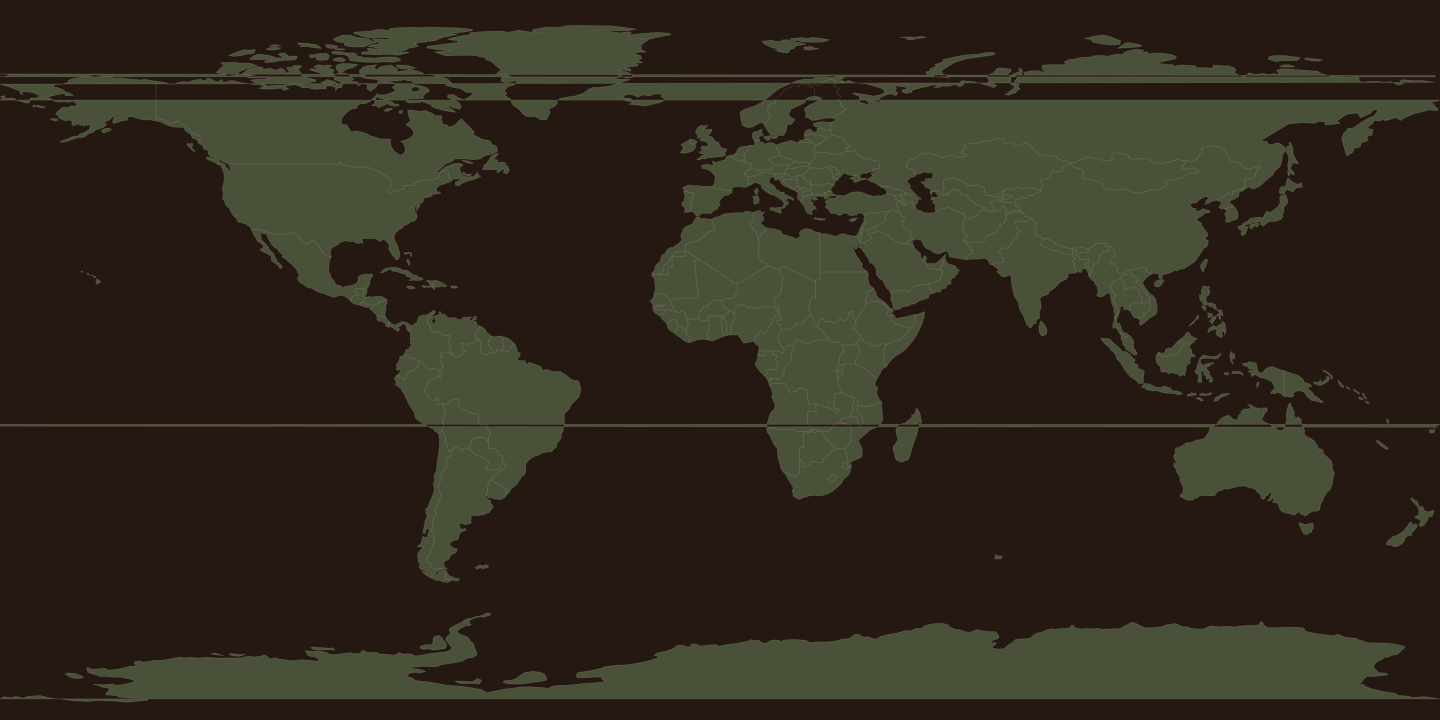
A qualitative orientation, not a live production ranking.
Origin field file / Latin America← All origins
Belize
Tiny volumes and Maya farming communities make partnership, aggregation and storytelling ethics central.
honeydried fruitspice
- Côte d’Ivoire — West Africa, Forest zone, at approximately 7.5° north and 5.5° west.
- Ghana — West Africa, Ashanti, Western North & Ahafo, at approximately 7.8° north and 1.0° west.
- Ecuador — Latin America, Esmeraldas, Manabí, Los Ríos & Guayas, at approximately 1.4° south and 78.2° west.
- Peru — Latin America, Amazonas, San Martín, Piura & Cusco, at approximately 9.2° south and 75.0° west.
- Venezuela — Latin America, Sur del Lago, Paria, Ocumare & Chuao, at approximately 7.0° north and 66.6° west.
- Dominican Republic — Caribbean, Cibao, Duarte & Sánchez Ramírez, at approximately 19.0° north and 70.2° west.
- Madagascar — East Africa, Sambirano Valley, at approximately 14.5° south and 47.0° east.
- Brazil — Latin America, Bahia & Pará, at approximately 10.0° south and 50.0° west.
- Indonesia — Southeast Asia, Sulawesi, Sumatra & Bali, at approximately 2.0° south and 119.0° east.
- India — India, Andhra Pradesh, Karnataka, Kerala & Tamil Nadu, at approximately 12.0° north and 77.5° east.
- Nigeria — West Africa, Ondo, Cross River & Osun, at approximately 9.0° north and 8.0° east.
- Cameroon — West Africa, Centre, South & Littoral, at approximately 6.0° north and 12.0° east.
- Papua New Guinea — Oceania, East New Britain & Bougainville, at approximately 6.0° south and 147.0° east.
- Belize — Latin America, Toledo District, at approximately 17.2° north and 88.7° west.
- Tanzania — East Africa, Mbeya, Morogoro & Kyela, at approximately 7.0° south and 35.0° east.
Atlas originBand is climatic orientation, not a biological border
Windows vary by region, weather and crop cycle.
System labels describe patterns, not every farm.
Each pressure requires its own evidence and response.
How to read this fileCountry is context,
Country is context,
never destiny.
Belize, especially the Toledo District, is closely associated with smallholder cacao, craft chocolate and Maya communities. Small volumes can enable specificity and relationship, but they can also invite outsider narratives that simplify living cultures.
Central collection and fermentation can turn many small farm harvests into consistent lots. The educational question is who governs that system, owns the quality knowledge and shares the resulting value.
Four forces to keep in frame.
Aggregation
Many small deliveries may be combined; traceability can remain community-level rather than farm-specific.
Central fermentation
Skilled teams can manage mass size and consistency better than many tiny on-farm batches.
Culture
Historical cacao knowledge should be credited without treating present-day communities as static relics.
Value
Tourism and craft premiums need transparent distribution and durable local institutions.
Sensory prompts—not promises
honey · dried fruit · spice · gentle cocoa
These associations can help build a flight. They cannot authenticate origin, genetics or quality. Taste blind when possible and record the roast, recipe and serving conditions.
Start a Belize tasting ↗Keep the caveats visible
— Maya is not a marketing aesthetic.
— Tiny origin does not mean farm-level traceability.
— Relationship stories need governance detail.
Turn romance into evidence.
- 01Who owns and runs fermentation?
- 02How are prices and services decided?
- 03How are communities represented and credited?
- 04What happens when export demand changes?