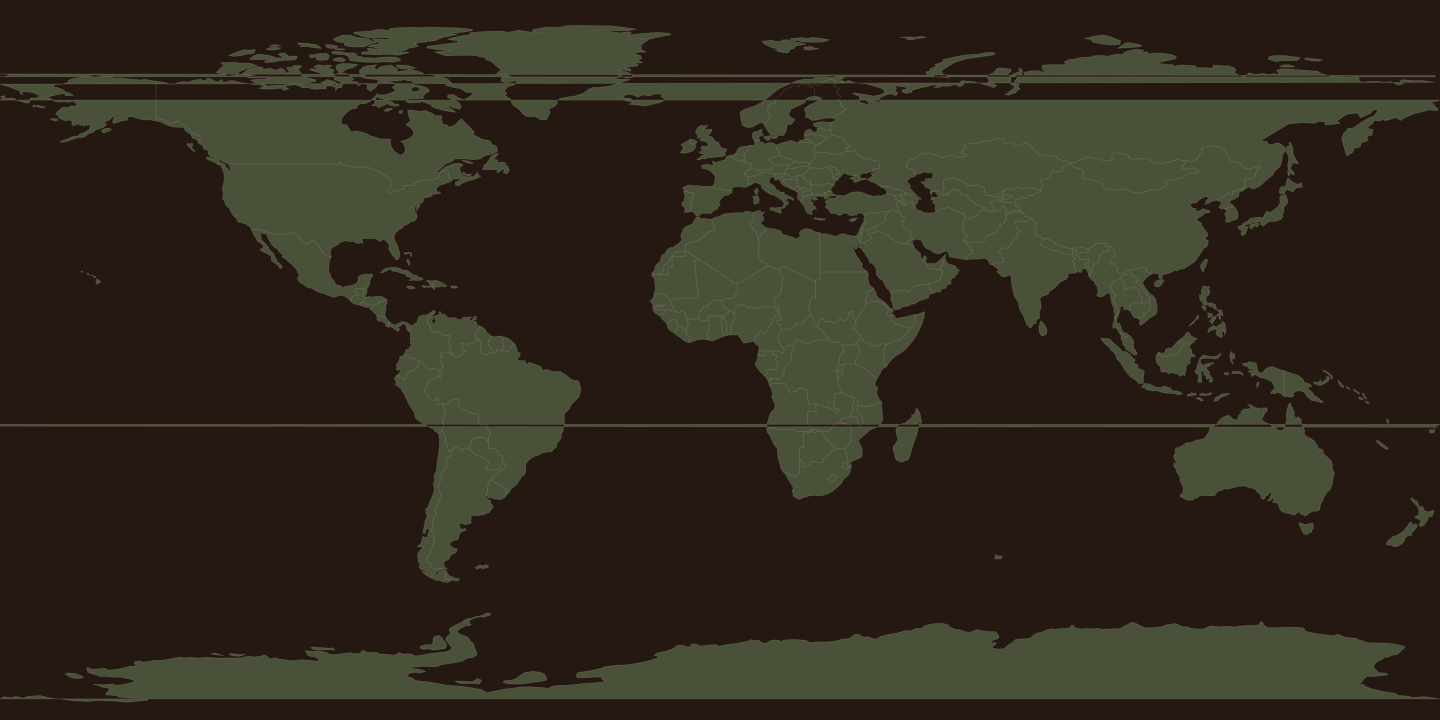
A qualitative orientation, not a live production ranking.
Origin field file / West Africa← All origins
Cameroon
Powerful cocoa, forest-frontier questions and smoke-linked processing show why a famous note needs diagnosis.
deep cocoaearthblack tea
- Côte d’Ivoire — West Africa, Forest zone, at approximately 7.5° north and 5.5° west.
- Ghana — West Africa, Ashanti, Western North & Ahafo, at approximately 7.8° north and 1.0° west.
- Ecuador — Latin America, Esmeraldas, Manabí, Los Ríos & Guayas, at approximately 1.4° south and 78.2° west.
- Peru — Latin America, Amazonas, San Martín, Piura & Cusco, at approximately 9.2° south and 75.0° west.
- Venezuela — Latin America, Sur del Lago, Paria, Ocumare & Chuao, at approximately 7.0° north and 66.6° west.
- Dominican Republic — Caribbean, Cibao, Duarte & Sánchez Ramírez, at approximately 19.0° north and 70.2° west.
- Madagascar — East Africa, Sambirano Valley, at approximately 14.5° south and 47.0° east.
- Brazil — Latin America, Bahia & Pará, at approximately 10.0° south and 50.0° west.
- Indonesia — Southeast Asia, Sulawesi, Sumatra & Bali, at approximately 2.0° south and 119.0° east.
- India — India, Andhra Pradesh, Karnataka, Kerala & Tamil Nadu, at approximately 12.0° north and 77.5° east.
- Nigeria — West Africa, Ondo, Cross River & Osun, at approximately 9.0° north and 8.0° east.
- Cameroon — West Africa, Centre, South & Littoral, at approximately 6.0° north and 12.0° east.
- Papua New Guinea — Oceania, East New Britain & Bougainville, at approximately 6.0° south and 147.0° east.
- Belize — Latin America, Toledo District, at approximately 17.2° north and 88.7° west.
- Tanzania — East Africa, Mbeya, Morogoro & Kyela, at approximately 7.0° south and 35.0° east.
Atlas originBand is climatic orientation, not a biological border
Windows vary by region, weather and crop cycle.
System labels describe patterns, not every farm.
Each pressure requires its own evidence and response.
How to read this fileCountry is context,
Country is context,
never destiny.
Cameroonian cacao is often described as deep, earthy or smoky. Some of that character may be welcome to a maker; some can arise from direct-fired drying, storage or roast. The useful task is to separate inherent potential from process signature.
Cocoa also intersects with forest landscapes and smallholder livelihoods. Traceability and land-use evidence must operate beyond a country name on the wrapper.
Four forces to keep in frame.
Drying
Smoke exposure can be a practical response to wet conditions, but uncontrolled contact creates persistent flavor and contamination concerns.
Forest
Expansion and farm mapping require landscape-specific evidence and respect for land rights.
Flavor
Deep cocoa can support bold styles; heavy roast can make every lot resemble the stereotype.
Traceability
Aggregation and informal channels complicate farm-level claims.
Sensory prompts—not promises
deep cocoa · earth · smoke · black tea
These associations can help build a flight. They cannot authenticate origin, genetics or quality. Taste blind when possible and record the roast, recipe and serving conditions.
Start a Cameroon tasting ↗Keep the caveats visible
— Smoky may be a defect or a choice.
— Dark roast can erase evidence.
— Traceable does not automatically mean deforestation-free.
Turn romance into evidence.
- 01Was smoke exposure measured or prevented?
- 02How deep is traceability?
- 03What land-use baseline is used?
- 04Can the lot be tasted under a lighter roast?