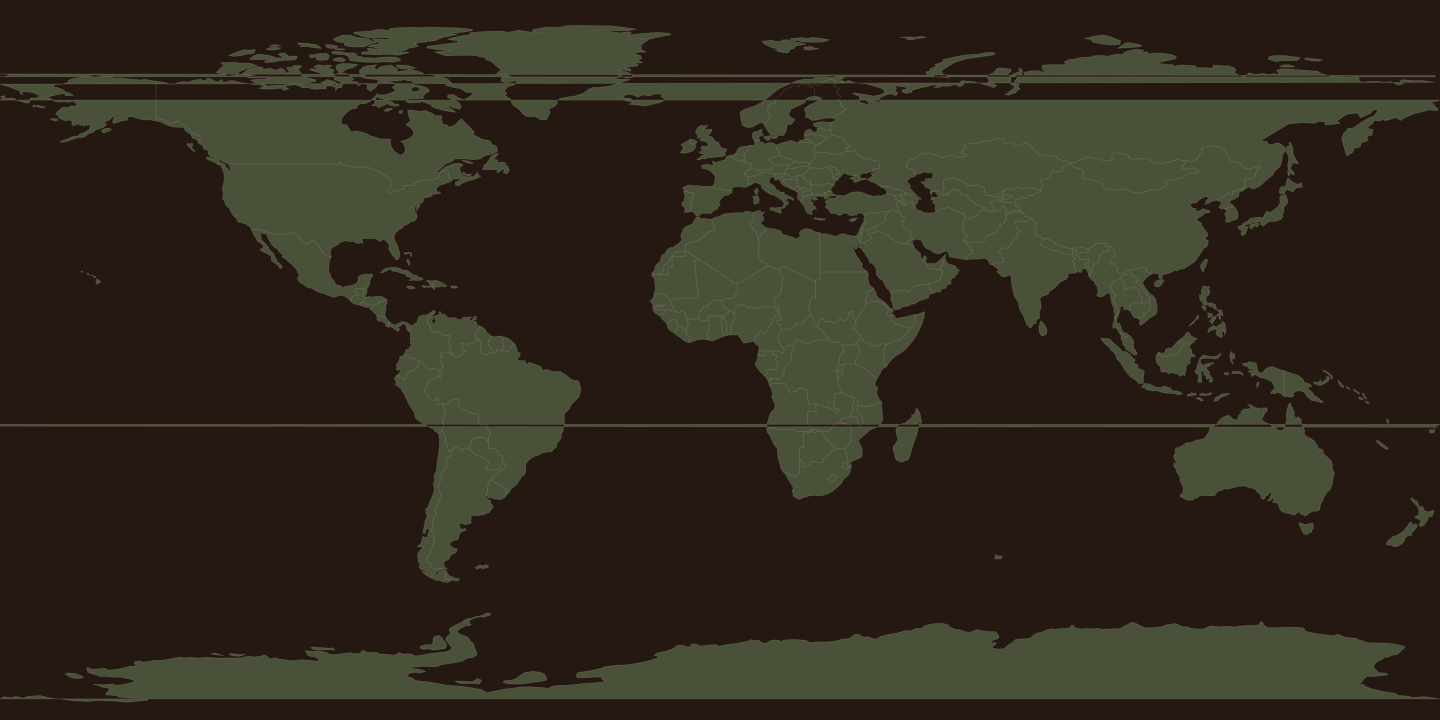
A qualitative orientation, not a live production ranking.
Origin field file / East Africa← All origins
Tanzania
Quality-focused hubs show how post-harvest organization can change an origin’s market reputation.
berrycitrusroasted nuts
- Côte d’Ivoire — West Africa, Forest zone, at approximately 7.5° north and 5.5° west.
- Ghana — West Africa, Ashanti, Western North & Ahafo, at approximately 7.8° north and 1.0° west.
- Ecuador — Latin America, Esmeraldas, Manabí, Los Ríos & Guayas, at approximately 1.4° south and 78.2° west.
- Peru — Latin America, Amazonas, San Martín, Piura & Cusco, at approximately 9.2° south and 75.0° west.
- Venezuela — Latin America, Sur del Lago, Paria, Ocumare & Chuao, at approximately 7.0° north and 66.6° west.
- Dominican Republic — Caribbean, Cibao, Duarte & Sánchez Ramírez, at approximately 19.0° north and 70.2° west.
- Madagascar — East Africa, Sambirano Valley, at approximately 14.5° south and 47.0° east.
- Brazil — Latin America, Bahia & Pará, at approximately 10.0° south and 50.0° west.
- Indonesia — Southeast Asia, Sulawesi, Sumatra & Bali, at approximately 2.0° south and 119.0° east.
- India — India, Andhra Pradesh, Karnataka, Kerala & Tamil Nadu, at approximately 12.0° north and 77.5° east.
- Nigeria — West Africa, Ondo, Cross River & Osun, at approximately 9.0° north and 8.0° east.
- Cameroon — West Africa, Centre, South & Littoral, at approximately 6.0° north and 12.0° east.
- Papua New Guinea — Oceania, East New Britain & Bougainville, at approximately 6.0° south and 147.0° east.
- Belize — Latin America, Toledo District, at approximately 17.2° north and 88.7° west.
- Tanzania — East Africa, Mbeya, Morogoro & Kyela, at approximately 7.0° south and 35.0° east.
Atlas originBand is climatic orientation, not a biological border
Windows vary by region, weather and crop cycle.
System labels describe patterns, not every farm.
Each pressure requires its own evidence and response.
How to read this fileCountry is context,
Country is context,
never destiny.
Tanzanian specialty lots, including those associated with Mbeya, have gained visibility for bright fruit and cocoa character. Central fermentation and quality-focused networks help demonstrate that origin reputation can be built through coordinated skill and market access.
The model still depends on durable local capacity. If equipment, expertise, ownership or buyer demand disappears, a premium reputation may not translate into resilience.
Four forces to keep in frame.
Hubs
Centralized fermentation can aggregate small deliveries while controlling mass size, turning and drying.
Quality feedback
Cut tests and sensory results become valuable when information returns to producers.
Regions
Mbeya and Morogoro differ; specialty visibility should not become a national flavor rule.
Durability
Local ownership, maintenance, finance and diverse buyers determine whether quality systems persist.
Sensory prompts—not promises
berry · citrus · roasted nuts · bright cocoa
These associations can help build a flight. They cannot authenticate origin, genetics or quality. Taste blind when possible and record the roast, recipe and serving conditions.
Start a Tanzania tasting ↗Keep the caveats visible
— Emerging origin is a market label, not a blank slate.
— Centralization can concentrate power.
— One famous lot cannot stand for a country.
Turn romance into evidence.
- 01Who owns the post-harvest hub?
- 02How are wet beans priced?
- 03Does feedback reach farmers?
- 04Can the system survive one buyer leaving?