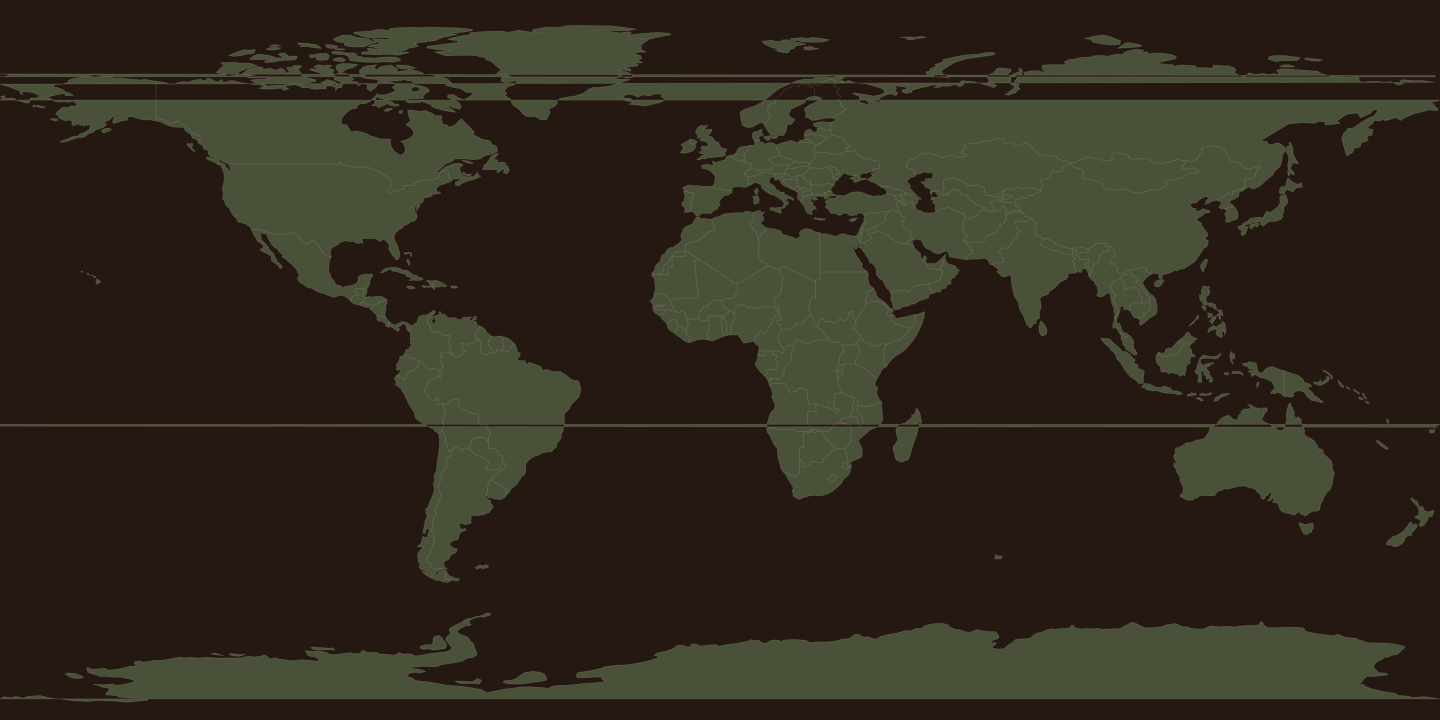
A qualitative orientation, not a live production ranking.
Origin field file / India← All origins
India
A young origin identity emerging through intercropped farms, monsoon logistics and a fast-growing domestic craft scene.
warm spicedried fruitnuts
- Côte d’Ivoire — West Africa, Forest zone, at approximately 7.5° north and 5.5° west.
- Ghana — West Africa, Ashanti, Western North & Ahafo, at approximately 7.8° north and 1.0° west.
- Ecuador — Latin America, Esmeraldas, Manabí, Los Ríos & Guayas, at approximately 1.4° south and 78.2° west.
- Peru — Latin America, Amazonas, San Martín, Piura & Cusco, at approximately 9.2° south and 75.0° west.
- Venezuela — Latin America, Sur del Lago, Paria, Ocumare & Chuao, at approximately 7.0° north and 66.6° west.
- Dominican Republic — Caribbean, Cibao, Duarte & Sánchez Ramírez, at approximately 19.0° north and 70.2° west.
- Madagascar — East Africa, Sambirano Valley, at approximately 14.5° south and 47.0° east.
- Brazil — Latin America, Bahia & Pará, at approximately 10.0° south and 50.0° west.
- Indonesia — Southeast Asia, Sulawesi, Sumatra & Bali, at approximately 2.0° south and 119.0° east.
- India — India, Andhra Pradesh, Karnataka, Kerala & Tamil Nadu, at approximately 12.0° north and 77.5° east.
- Nigeria — West Africa, Ondo, Cross River & Osun, at approximately 9.0° north and 8.0° east.
- Cameroon — West Africa, Centre, South & Littoral, at approximately 6.0° north and 12.0° east.
- Papua New Guinea — Oceania, East New Britain & Bougainville, at approximately 6.0° south and 147.0° east.
- Belize — Latin America, Toledo District, at approximately 17.2° north and 88.7° west.
- Tanzania — East Africa, Mbeya, Morogoro & Kyela, at approximately 7.0° south and 35.0° east.
Atlas originBand is climatic orientation, not a biological border
Windows vary by region, weather and crop cycle.
System labels describe patterns, not every farm.
Each pressure requires its own evidence and response.
How to read this fileCountry is context,
Country is context,
never destiny.
Indian cacao is concentrated in southern states and commonly grown with coconut, areca and other crops. Domestic bean-to-bar makers increasingly work with farmers and centralized post-harvest systems, making the origin visible to Indian eaters rather than only as an industrial ingredient.
A young specialty identity has advantages: experimentation is active and origin stories can remain connected to local makers. It also needs careful language, because small sample sizes and rapidly changing practices make national flavor stereotypes premature.
Four forces to keep in frame.
Intercropping
Cacao often fits beneath taller commercial crops; shade, irrigation and farm economics differ from forest analogies.
Monsoon
High humidity and rain complicate drying, requiring covers, raised beds, solar systems or controlled equipment.
Domestic value
Indian makers can shorten cultural and logistical distance, though direct relationships still need transparent terms.
Regional learning
Kerala, Karnataka, Tamil Nadu and Andhra Pradesh are developing distinct farm and post-harvest networks.
Sensory prompts—not promises
warm spice · dried fruit · nuts · mellow cocoa
These associations can help build a flight. They cannot authenticate origin, genetics or quality. Taste blind when possible and record the roast, recipe and serving conditions.
Start a India tasting ↗Keep the caveats visible
— Indian cacao is not one profile.
— Tree-to-bar does not by itself prove outcomes.
— Fast growth makes current verification important.
Turn romance into evidence.
- 01Which state and farm system?
- 02How was monsoon drying managed?
- 03Who owns the fermentation infrastructure?
- 04Is the maker reporting harvest and batch data?